

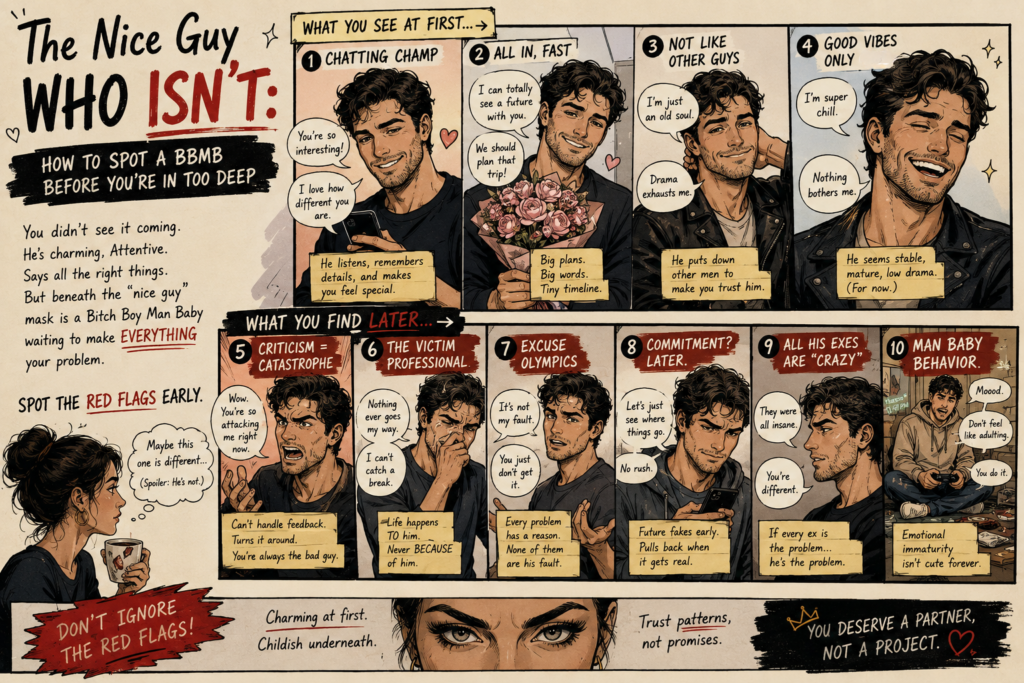
You didn’t see it coming. That’s the thing nobody tells you about dating a B!tch Boy Man Baby. You think you’ll be able to spot one immediately, like he’s going to show up to the first date wearing a “I Have Zero Emotional Accountability” t-shirt and immediately blame the waiter for his own inability to choose an entrée. But that’s not how it works. The BBMB rarely announces itself. He doesn’t arrive waving red flags like a man possessed. He arrives with flowers, or a very well-researched compliment about something in your dating profile, or an almost suspiciously good first-date story about the time he rescued a dog.
He’s charming. He seems interested. He asks follow-up questions, which already puts him ahead of roughly 40 percent of the dating pool. You think, maybe this one is different. Maybe this one is actually ready for something real.
And then, six weeks or six months later, you’re googling “why does my boyfriend treat criticism like a personal attack” at midnight and wondering how you got here.
You got here because the BBMB is extremely good at the beginning. The beginning is his Olympic event. What follows is a guide to spotting him before you’re emotionally invested, when the red flags are still subtle enough to miss if you don’t know what you’re looking for. Consider this your early warning system.
First, Let’s Define the Species
The B!tch Boy Man Baby (BBMB) is not a clinical diagnosis. It’s a behavioral pattern, a recognizable archetype defined by a specific cluster of traits that make him consistently, exhaustingly difficult to be in a relationship with. At his core, the BBMB is a man who has never developed the emotional maturity his age technically requires. He possesses the emotional regulation skills of a much younger person, combined with the audacity of someone who has never once been told that his behavior has consequences.
He’s the man who genuinely cannot understand why you’re upset when he does something upsetting. The man who can construct a 20-minute argument for why anything that goes wrong is technically your fault. The man who describes all his ex-girlfriends as “crazy” without any apparent awareness of the statistical improbability of that claim. The man who is brilliant at performing emotional intelligence without actually possessing it.
He’s not always aggressive or obviously awful. Sometimes he’s soft-spoken and seemingly sensitive. Sometimes he presents as deeply spiritual or intellectual. Sometimes he’s the funniest person in the room. The BBMB comes in many flavors, but the core ingredients are always the same: profound emotional immaturity, an allergic reaction to accountability, an insatiable need for validation, and a truly impressive talent for making his problems everyone else’s responsibility.
The Signature Opening Move: Love Bombing
The BBMB’s most effective early tactic isn’t always something he consciously chooses, which makes it harder to identify. Love bombing, the practice of overwhelming a new romantic interest with intense attention, affection, and validation, can feel indistinguishable from genuine enthusiasm. When someone is really into you, they text a lot. They want to see you. They say nice things. So how do you tell the difference between a man who’s genuinely excited about you and one who’s trying to manufacture dependency before you can see him clearly?
The intensity is the clue. The BBMB doesn’t just text often. He texts in a way that makes you feel faintly responsible for his emotional state if you don’t respond quickly enough. He doesn’t just want to see you frequently. He makes plans for months ahead after knowing you for days, as if he’s staking a claim rather than building something. He doesn’t just compliment you. He tells you that you’re different from everyone else, not like other girls, more interesting and intelligent and beautiful than anyone he’s ever met, and he does this before he actually knows you well enough to determine any of those things.
This isn’t romance. This is a man securing his supply of validation before you’ve had a chance to evaluate whether he deserves your attention. His nervous system requires external approval to function, and he’s identified you as a potential source. The love bombing phase is him locking that down.
Watch for future faking, too. The BBMB will make sweeping declarations about your shared future at a pace that should feel alarming. “We should do that next summer” in week two. “I could really see myself with you forever” in week three. This isn’t confident romantic expression. It’s an attempt to emotionally commit you to the relationship before you have enough information to make that decision clearly.
The “Alpha” Paradox
One of the most reliable early indicators of a BBMB is the gap between how he presents himself and how he actually functions when something requires effort or adaptation.
He may talk a great deal about being a leader, being decisive, knowing what he wants. He uses words like “alpha” unironically, or adjacent language about being driven, self-made, clear about his standards. He presents an image of competence and quiet dominance.
And then the restaurant is fully booked.
Watch what happens when something small goes wrong. Not a crisis. Just the minor, routine inconveniences of being a person alive in the world. Does he pivot and solve the problem? Or does he deflect, fuss, get disproportionately irritated, or immediately look to you to fix it? The BBMB tends to perform confidence in the abstract while crumbling under the weight of the specific. He knows what he wants, but he struggles to do what’s required to get it. He values leadership, but he’d rather you make the actual decision so there’s someone to blame if it goes badly.
This paradox extends to emotional territory, too. He may speak frequently about emotional intelligence, about having done “the work,” about valuing depth and authenticity in relationships. And in the early weeks, he’ll seem to back this up. He’ll share things about his past. He’ll seem to listen. But pay attention to whether the emotional conversation flows in both directions, or whether you’ve somehow become the audience for his one-man show. Does he ask about your experiences and actually listen to your answers? Or does your sharing primarily prompt him to relate everything back to himself?
“I’m Just Bad at Texting”
This phrase, delivered with a particular combination of sheepishness and pre-emptive defensiveness, is one of the BBMB’s most reliable tells. He announces his communication failures upfront, not as an apology or an acknowledgment of something he’s working on, but as a fixed characteristic you should simply accommodate. Like mentioning he doesn’t like spicy food. Just a fact about him. Just something you should know.
The problem with this framing becomes apparent when you notice that he is, in fact, excellent at texting. He responds instantly to his friends. He sends screenshots and memes and updates throughout the day. He maintains long, engaged text conversations about subjects that interest him. His thumbs work perfectly. His interest in communicating with you is the variable, not his ability.
And here’s the thing that makes this particularly maddening: the double standard almost always emerges quickly. He gets to be intermittently available, slow to respond, and generally low-effort in communication. But if you display even a fraction of the same behavior, there will be consequences. Not proportionate, reasonable consequences like him being mildly disappointed. Consequences like accusatory messages demanding to know why you haven’t responded, or sulky silences designed to punish you for having the audacity to not revolve your attention entirely around him.
This isn’t about texting. It’s about a man who requires your constant availability while offering his own only when convenient, and who has already decided this asymmetry is normal and fair.
The Ex-Girlfriend Report
Ask a man about his past relationships early enough in dating and you’ve got yourself a highly informative diagnostic tool. Not because you need to audit his romantic history, but because the way someone talks about past partners reveals a great deal about their capacity for self-reflection and accountability.
A reasonable person, describing why past relationships ended, will acknowledge complexity. Things weren’t working. We wanted different things. I wasn’t in a great place at the time. She needed something I couldn’t give her. There’s usually some ownership, some acknowledgment that two imperfect humans tried and failed to build something together.
The BBMB’s ex-girlfriend report sounds very different. Every ex is a cautionary tale. They were too needy, too dramatic, too crazy, too controlling, too sensitive, too difficult. He was endlessly patient and generous, and they were inexplicably impossible. He tried so hard. They just couldn’t appreciate it.
When every single past relationship is someone else’s fault, you are not listening to an honest accounting of romantic history. You are listening to a man who has never once examined his role in a failed relationship, which means he has never grown from one. You will not be the exception. You will be described to his next girlfriend in the same bewildered, wounded tones currently being used about his last one.
Strategic Trauma Dumping
Vulnerability in relationships is healthy and important. The ability to share difficult experiences, to trust another person with your struggles, is a sign of genuine intimacy. The BBMB has figured this out, which means he’s learned to perform vulnerability strategically.
By the second or third date, sometimes even the first extended conversation, the BBMB may unload a substantial amount of personal history. Difficult childhood. Painful past relationships. Betrayals by people he trusted. He shares this with an air of brave honesty, of finally letting someone see the real him.
This might be genuine. But watch for a few things. First, is this sharing mutual, or is it one-directional? Genuine vulnerability is an invitation to connection, not a performance requiring an audience. Second, does the sharing seem calibrated to elicit sympathy rather than understanding? There’s a difference between someone processing difficult experiences and someone deploying them for effect. Third, and most importantly, do these early revelations come with a built-in excuse package? If the stories about his past are structured in a way that preemptively explains any future bad behavior, you are being set up.
“I have a hard time trusting people because of how I was hurt before” sounds like vulnerability. It can also function as advance notice that he will be accusatory and controlling, and that you’ll be expected to absorb this because of something that happened to him years before he met you.
What He Does with “No”
There is no faster, more reliable way to understand a man’s character than to say no to him and observe what happens next. Not a dramatic no. Not a confrontation. Just a simple, ordinary no of the kind that comes up in any real relationship. No, I can’t make it that night. No, I’m not comfortable with that. No, I’d actually prefer something different.
A person with basic emotional maturity will hear this no, may express some disappointment if relevant, and will move on without incident. They understand that you are a separate person with your own preferences and prior commitments, and they don’t experience your autonomy as an affront.
The BBMB experiences “no” as an attack. Not always overtly, at least not at first. It might start with a particular tone, a slightly wounded energy, a subtle shift in warmth that lets you know you’ve done something wrong by having a prior engagement on Wednesday. He might not say anything directly but will express his displeasure through passivity, through a sudden decline in the attentiveness he was providing, through pointed questions about why you can’t make it or who you’ll be with instead.
Over time, if the relationship continues, this escalates. The no becomes an argument. The argument becomes you reassuring him that you still care about him, that you’re still interested, that the Wednesday commitment doesn’t mean anything about your feelings for him. You’ve been successfully redirected from the original subject, which was a Wednesday you had prior plans, into managing his emotional response to your autonomy. This will keep happening, and it will keep escalating, unless you end it.
The “Men Have Feelings Too” Deflection
This one requires some care because the statement itself is true and important. Men do have feelings, and those feelings deserve acknowledgment and space. The emotional restriction imposed on men by toxic masculine norms causes real damage. Advocating for men’s emotional lives is not the problem.
The problem is when this legitimate principle gets deployed as a weapon specifically when the BBMB has been called out for something. When you raise a concern, offer gentle feedback, or express that something hurt you, and his immediate response is to pivot to a speech about how men are always told their feelings don’t matter, pay attention. You haven’t said anything about his feelings. You raised an issue about his behavior. He’s using the language of emotional sensitivity to avoid any engagement with the substance of your concern.
Real emotional intelligence in men doesn’t sound like this. It sounds like, “I hear that. Let me think about what you’re saying.” It sounds like acknowledgment before defense. It sounds like the ability to hold two things at once: that he might have genuinely hurt you, and that he still has value as a person. The BBMB cannot do this because holding both requires emotional sophistication he hasn’t developed. So instead he flips the script, makes himself the wronged party, and exits the conversation having avoided all accountability while somehow leaving you feeling vaguely guilty.
The Most Important Question
Before we close, here is the most useful diagnostic question you can apply to anyone you’re dating, at any point in the process. It’s not about his job or his childhood or his communication style. It’s simpler than that.
Does being around this person make you feel more like yourself or less?
The BBMB, over time, tends to produce a particular kind of erosion. You find yourself editing your responses to avoid triggering his defensiveness. You second-guess your perceptions because he’s questioned them enough times. You apologize for things that aren’t your fault because it’s easier than the alternative. You manage his mood before he arrives so that the evening goes smoothly. You become smaller and more careful, spending energy that should go toward your own life on the maintenance of his emotional comfort instead.
This doesn’t happen all at once. It’s gradual enough that you might not notice until you’re well inside it. Which is why the early warning signs matter. The small moments of texting hypocrisy and wounded responses to ordinary nos and pre-packaged trauma dumps are telling you something important about who this person is and what a future with him actually looks like.
You deserve someone whose presence expands your life rather than shrinks it. Someone who hears “no” without punishment. Someone whose ex-girlfriends were human beings with legitimate perspectives rather than a parade of cautionary tales. Someone who can be accountable without collapsing.
Those people exist. The first step toward finding one is knowing what you’re not looking for.
The Rise of the B!tch Boy Man Baby by A.M. Ber examines this archetype in depth, from early dating red flags to the broader cultural and political implications of emotional immaturity in positions of power. Available now.