

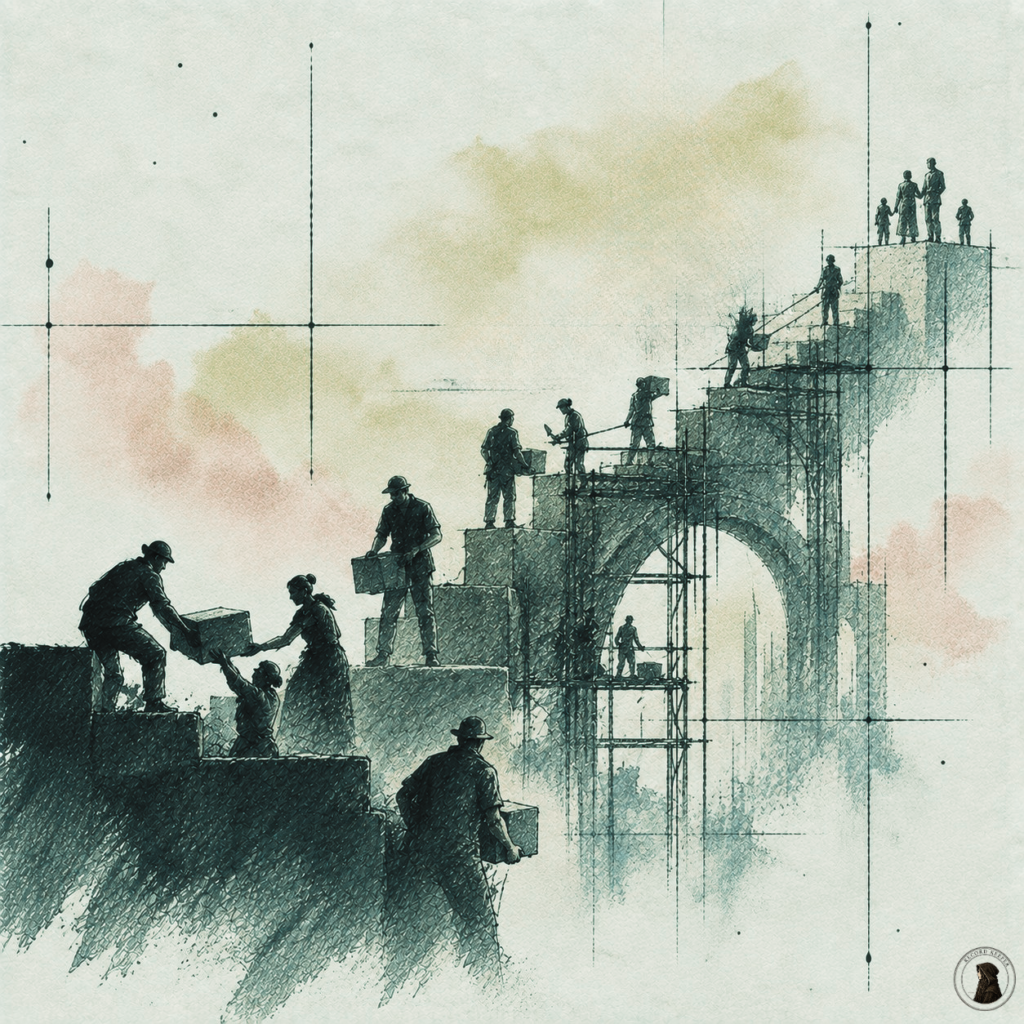
We love the story of the lone genius.
Someone sits in a workshop, laboratory, garage, dorm room, or office and sees something nobody else sees. An inventor creates a machine. A scientist makes a discovery. An entrepreneur builds a company. A brilliant person has an idea that changes the world. We put that person’s name on the invention, write books about them, make movies about them, and sometimes make them extraordinarily wealthy.
There is nothing wrong with recognizing individual achievement. Some people really do see possibilities other people miss. Some take enormous risks. Some spend decades mastering a field, sacrifice financial security to pursue an idea, or have the rare ability to turn something theoretical into something millions of people can actually use. Individual creativity, intelligence, persistence, and ambition have driven human progress in extraordinary ways.
But nobody starts from zero.
Take away the language an inventor was taught as a child. Take away mathematics, electricity, roads, schools, libraries, universities, banking, contract law, metallurgy, computers, the scientific method, the electrical grid, telecommunications, modern medicine, previous inventions, and everything humanity already knows about the physical world. Take away the teachers who educated the engineers, the workers who built the laboratory, the people who maintain the power grid, the farmers who produced the food everyone ate while they worked, and the generations of researchers whose discoveries became so ordinary that nobody thinks to mention their names anymore.
Now ask our lone genius to change the world.
Like it or not, human progress has always been a collective effort.
Nobody Starts at the Beginning
Every human being is born into a world already under construction. Before we contribute a single thing to it, we inherit an almost unimaginable amount of accumulated human knowledge.
Language may be the easiest place to see it. None of us invented the language we use to think, communicate, argue, write, teach, or imagine. Generations of people who lived before us created, modified, preserved, and passed down the words and grammatical structures we begin absorbing before we are old enough to understand what language is.
The same is true of numbers and mathematics. A child learning multiplication is receiving knowledge that took human civilization centuries to develop. A teenager learning algebra can acquire in a school year mathematical tools that some of the most brilliant people in earlier civilizations never possessed. A university student studying physics begins with principles that required generations of observation, argument, experimentation, error, correction, and discovery to establish.
This is so normal that we barely notice how extraordinary it is. Human beings do not have to rediscover fire with every generation. We do not have to reinvent the wheel, rediscover germs, recreate written language, independently figure out electricity, or personally map the planet before we can begin contributing something new.
We inherit the work.
Then, if we are lucky, we add something to it.
Who Invented the Smartphone?
Consider something most of us carry around without giving much thought to how absurdly complicated it actually is: the smartphone.
Who invented it?
There are people and companies that deserve enormous credit for developing particular devices and turning existing technologies into products that transformed daily life. But there is no single person who can reasonably claim to have invented everything necessary to create a modern smartphone.
To build one, humanity first needed to understand electricity and electromagnetism. We needed telegraphy, telephony and radio communication. We needed transistors, integrated circuits, microprocessors, computer memory, digital cameras, lithium-ion batteries, touchscreens, wireless networking, satellites, GPS, programming languages, operating systems, data compression, the internet, materials science, precision manufacturing, and an enormous global telecommunications infrastructure.
Each item on that list has its own history. Follow almost any one of them backward and you find another network of discoveries, experiments, researchers, engineers, institutions, businesses, governments, universities, workers, and previous inventions.
Then there is the physical object itself. Someone has to extract the raw materials. Someone has to process them. Factories have to manufacture the components. Ships, trucks, trains, and aircraft have to move materials and products through supply chains. Engineers have to design manufacturing systems. Workers have to assemble, test, package, transport, sell, repair, and support the devices. Telecommunications companies have to maintain networks so the phones remain useful after they leave the box.
There are certainly individuals and companies within that chain whose contributions are much greater than others. Recognizing the collective nature of an achievement does not require pretending everyone contributed equally.
It simply requires acknowledging that nobody did it alone.
Even Newton Was Standing on Someone Else’s Shoulders
Isaac Newton famously wrote that if he had seen farther, it was because he was “standing on the shoulders of giants.” The phrase is wonderfully appropriate for this discussion, partly because even Newton was not the first person to express the idea.
That is how knowledge works.
A scientist does not begin a career by personally verifying every scientific discovery made during the previous five hundred years. An engineer does not derive all of mathematics from first principles before designing a bridge. A doctor does not rediscover anatomy before learning surgery. A computer programmer does not begin by inventing the transistor.
We trust, test, challenge, refine, and build upon knowledge accumulated by other people.
Sometimes the contribution that changes everything is not even a completely new discovery. Someone connects two ideas that previously existed separately. Someone finds a practical application for a scientific principle. Someone makes an expensive technology cheap enough for ordinary people. Someone improves a manufacturing process enough to make mass production possible. Someone recognizes a market nobody else noticed.
Innovation is often less like pulling an idea from nowhere and more like adding another floor to a building that has been under construction for thousands of years.
The new floor can be magnificent. The person who designed it may deserve enormous credit.
But there are still a lot of floors underneath it.
The Government Is Already in Your Smartphone
This becomes particularly interesting when we talk about the relationship between public and private innovation.
American political arguments often present government and private enterprise as opposing forces. Government is portrayed as slow, bureaucratic, and wasteful, while private enterprise is innovative, efficient, and dynamic. There are plenty of examples supporting every one of those criticisms of government, just as there are extraordinary examples of private-sector innovation.
Reality is considerably more intertwined.
Government-funded research has played important roles in technologies that later became foundations for private industry. The internet grew partly from federally funded computer-networking research. GPS was developed by the U.S. Department of Defense. Government research, procurement, and defense spending played important roles in the development of early semiconductor technology. Universities supported by public research money have produced discoveries that eventually became commercially valuable technologies and medicines.
That does not mean “the government invented the smartphone,” any more than it means private companies merely took something taxpayers had already finished and put it in a box.
Turning research into a product can be an extraordinary achievement of its own. Companies raise capital, accept risk, solve engineering problems, design products, build supply chains, create manufacturing systems, figure out what consumers want, compete with other companies, and sometimes spend billions of dollars developing ideas that fail.
The more accurate story is also the more interesting one. Public research and private innovation often build on one another. Universities, governments, companies, investors, workers, and consumers participate in different parts of the process.
We keep trying to turn human progress into an ideological competition between the public and private sectors when much of modern civilization was built through interaction between them.
The Invisible People Behind Great Achievements
There is another problem with the lone-genius story. It tends to erase the people whose labor made the genius’s work possible.
We remember the scientist but rarely the person who manufactured the laboratory equipment. We remember the industrialist but not the thousands of workers who built the product. We remember the architect but not every construction worker who turned the drawing into a building. We remember the founder of the company but not the teachers who educated its engineers, the electricians who keep its servers running, or the sanitation workers who make the city containing its headquarters habitable.
The circle becomes even larger when we consider care work. Who raised the scientist? Who prepared meals while someone worked sixteen-hour days building a company? Who watched the children? Who cared for an elderly parent? Who kept a household functioning while another person’s work became the work history remembers?
For much of history, women performed enormous amounts of this labor without wages, titles, patents, biographies, or public recognition. Their work did not become economically meaningless simply because nobody put a price on it.
This does not mean every person who contributed indirectly to an invention deserves equal credit for it. That would make the concept of individual accomplishment meaningless. The engineer who solves a problem deserves credit for solving it. The entrepreneur who risks everything on an idea deserves credit when it succeeds. The scientist who makes a breakthrough deserves recognition for the breakthrough.
But there is a difference between saying I accomplished something extraordinary and saying I accomplished it alone.
The first can be true.
The second almost never is.
“Self-Made” Is Doing a Lot of Work
This is why I have trouble with the phrase self-made.
It usually means something much narrower than the words suggest. A self-made millionaire did not inherit the million dollars. A self-made entrepreneur built a business rather than inheriting one. Those distinctions can be meaningful, particularly in societies where inherited wealth creates enormous advantages.
But nobody is literally self-made.
The successful business owner used roads someone else built, currency backed by institutions they did not create, courts that enforce contracts, an educated workforce, telecommunications networks, banking systems, electrical infrastructure, property law, emergency services, and a market filled with customers whose own economic activity depends on the same enormous system.
That does not mean the government deserves the person’s business. It does not mean success is illegitimate, or that everyone who had access to those systems would have accomplished the same thing. Clearly they would not.
It means success happens inside a civilization.
This is where conversations about individualism sometimes become unnecessarily silly. We act as though acknowledging interdependence somehow diminishes individual responsibility. It doesn’t.
I can be responsible for my choices and still depend on other people. I can admire someone’s extraordinary accomplishment while recognizing the infrastructure that made it possible. I can support entrepreneurship and private property while acknowledging the importance of public investment. I can believe someone deserves to become wealthy from an invention without pretending that person independently invented mathematics, electricity, roads, computers, and contract law along the way.
Individualism and interdependence are not opposites.
They describe different parts of being human.
Civilization Itself Is the Invention
If we pull back far enough, the most extraordinary human invention may not be any particular machine.
It may be our ability to accumulate knowledge across generations.
Other animals can learn. Some use tools. Some teach behaviors to their young. Some have remarkably complex social systems. Human beings, however, have developed extraordinary ways to preserve information outside an individual brain and transmit it across enormous distances and periods of time.
Writing allowed a person to communicate with people who had not yet been born. Printing dramatically expanded the number of people who could access recorded knowledge. Libraries preserved it. Schools transmitted it. Universities organized and expanded it. Scientific journals allowed researchers to compare discoveries. Telecommunications accelerated the exchange. The internet made staggering amounts of human knowledge accessible almost instantly.
A person can now sit at a kitchen table and learn from a mathematician who died centuries ago, watch a lecture delivered on another continent, read a digitized manuscript from an ancient civilization, study instructions written by a stranger, and communicate with experts around the world.
That ability compounds.
One generation discovers something. Another preserves it. Someone else improves it. Another person combines it with a discovery made somewhere else. Someone finds an application nobody previously imagined. Someone teaches it. Someone translates it. Someone challenges it. Someone discovers part of it was wrong and replaces it with something better.
Human progress is not a relay race in which one person simply hands a baton to the next. It is more like billions of people adding pieces to an enormous structure that no individual will ever live long enough to see completed.
AI Makes the Collective Nature of Progress Harder to Ignore
Artificial intelligence brings this question into particularly sharp focus because AI may be one of the clearest examples we have ever created of cumulative human knowledge becoming economically productive.
The AI systems being developed today did not emerge from nowhere. They depend on decades of research in computer science, mathematics, statistics, linguistics, machine learning, semiconductor technology, networking, data storage, and countless related fields. They depend on enormous physical infrastructure, including data centers, electrical systems, fiber networks, cooling systems, and sophisticated chips.
They also depend, in different ways and to different degrees, on enormous amounts of material created by human beings. Books, articles, websites, photographs, artwork, software code, scientific papers, conversations, databases, and other forms of human-created information became part of the environment from which modern AI developed.
That raises difficult questions about copyright, compensation, consent, ownership, and intellectual property that we are only beginning to work through. But it also raises a larger philosophical question.
If artificial intelligence eventually becomes capable of creating enormous amounts of economic value from systems built upon generations of accumulated human knowledge, who should benefit from that productivity?
The companies developing advanced AI have legitimate claims. They employ researchers and engineers, purchase expensive computing infrastructure, raise capital, take enormous financial risks, and perform work that did not happen automatically merely because previous knowledge existed.
But recognizing their contribution does not require pretending the final company created the entire chain.
The same is true of every transformative technology.
And as AI becomes more economically important, this distinction may stop being philosophical and become extremely practical.
If Progress Is Collective, Who Gets the Benefits?
This is where this discussion connects directly to the future of work.
If AI and robotics eventually allow society to produce substantially more with substantially less human labor, we will have created an enormous new pool of economic value. The question will be how that value moves through society.
Some may appear as lower prices. Some may become higher wages. Some may fund new businesses and industries. Some may become corporate profits and investor returns. Some may be captured through taxation and converted into public services. Some may allow people to work fewer hours. Some may become extraordinary fortunes.
There is no reason all of those things cannot happen simultaneously.
The important point is that the distribution will not be determined by technology itself. It will be shaped by ownership, markets, laws, taxation, competition, labor power, intellectual property rules, public investment, and political choices.
If the technologies creating enormous new wealth were themselves built upon generations of public research, private investment, accumulated knowledge, infrastructure, workers, creators, scientists, educators, and institutions, then it is reasonable to ask whether the prosperity they create should also have some broadly shared benefits.
That does not require believing everyone deserves an identical share. Collective contribution does not mean equal contribution, and it certainly does not require erasing the people whose extraordinary work moves humanity forward.
It does mean we should be skeptical of a system in which the collective inheritance of human civilization becomes the raw material for prosperity that flows almost entirely to a tiny number of owners.
Cooperation Does Not Make Us Saints
There is a temptation to turn an argument about collective human achievement into a sentimental story about humanity working together.
That would be dishonest.
We have built civilization through cooperation, but also through competition, conquest, exploitation, slavery, colonialism, war, theft, coercion, and tremendous inequality. Knowledge has been stolen. Workers have been exploited. Indigenous discoveries have been appropriated. Scientific achievements have been used to build weapons. Governments have suppressed inventors and thinkers, while corporations have sometimes used power to crush competitors or workers.
Human progress is not evidence that human beings are naturally generous or cooperative.
It is evidence that even our competition occurs inside systems built by other people.
Wars themselves have accelerated technological development. Rival companies push each other to innovate. Countries compete for scientific leadership. Inventors want recognition. Entrepreneurs want profit. Researchers want to solve problems, advance careers, win prizes, or simply satisfy curiosity.
Collective progress does not require collective motivation.
Millions of people can pursue completely different goals and still contribute pieces to the same larger structure.
That is one of the fascinating things about civilization.
We Owe the Past More Honesty and the Future More Imagination
Recognizing the collective nature of progress changes how we look backward. The history of civilization becomes larger than a parade of famous men, presidents, generals, inventors, industrialists, and scientists. Those people still matter, sometimes enormously, but they exist within networks of people whose names we may never know.
It also changes how we think about what we owe the future.
We inherited an astonishing amount from people who never knew we would exist. Someone planted trees whose shade they would never sit beneath. Someone conducted an experiment whose practical application would not be discovered for decades. Someone built a bridge that outlived them. Someone wrote a book that reached readers centuries later. Someone fought for a right that future generations would consider ordinary. Someone taught a child who eventually taught another child who eventually discovered something important.
Most of the people who built the world we inherited received no direct benefit from our use of it.
They simply added their piece.
We are doing the same thing now, whether we think about it that way or not. The infrastructure we build, scientific knowledge we develop, institutions we strengthen or weaken, environmental damage we create or prevent, technologies we regulate or fail to regulate, and political systems we preserve will become someone else’s inheritance.
That should make us a little more humble about the idea that anything is entirely ours.
Civilization Is a Group Project
None of this requires diminishing individual achievement. I want brilliant people trying impossible things. I want scientists competing to make discoveries, entrepreneurs building companies, artists creating work nobody has seen before, engineers solving problems, inventors tinkering in garages, and ambitious people becoming successful because they made something valuable.
Individual achievement is one of the engines of human progress.
But it is not the whole engine.
Every inventor inherited tools. Every scientist inherited knowledge. Every entrepreneur inherited infrastructure. Every writer inherited language. Every generation inherited a civilization built partly by people whose names have disappeared from history.
We are individuals, but we are not independent of one another. We never have been.
That becomes especially important as we enter a period when technologies built from accumulated human knowledge may generate levels of productivity previous generations could barely imagine. We are going to have arguments about who owns those technologies, who deserves the profits, what workers are owed, what creators are owed, what taxpayers are owed, what companies are owed, and what society owes the people disrupted by change.
Those arguments will be complicated, and there will not be one neat ideological answer to all of them. But we should begin them with an accurate understanding of how we got here.
No person alive created the world they started with. We inherited languages we did not invent, knowledge we did not discover, infrastructure we did not build, institutions we did not establish, and technologies resting on generations of work we did not perform. Whatever we accomplish during our own lives will become part of that inheritance for somebody else.
Every generation receives a world it did not build, adds what it can, and passes the result to people it will never meet. Perhaps the real measure of progress is not how much of that inheritance we manage to claim as our own, but how much more possibility we leave behind for the people who come next.
