

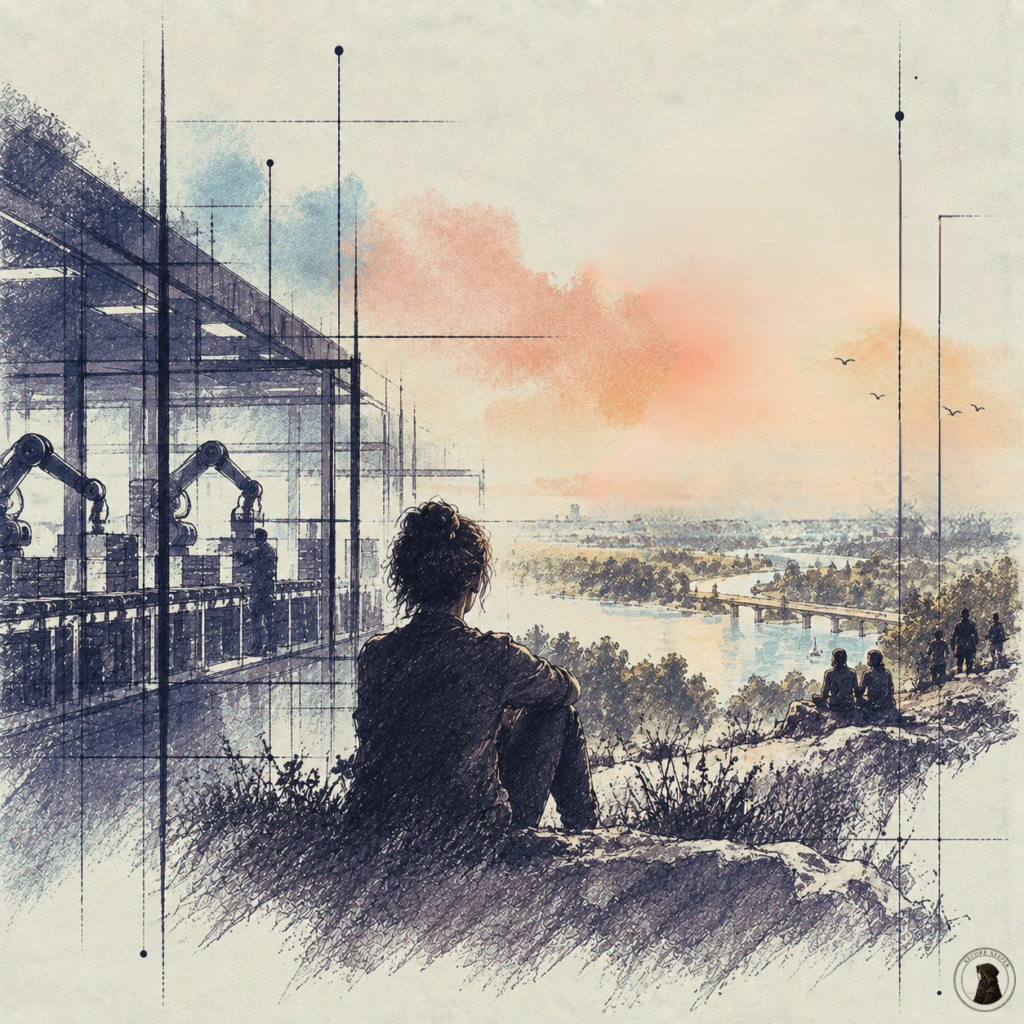
For most of human history, producing the things people needed required an enormous amount of human labor. Growing food, making clothing, building houses, moving goods, keeping records, manufacturing tools, and nearly everything else depended on people spending large portions of their lives working. Technology gradually changed that relationship. One farmer with modern machinery can produce what once required many workers. A factory can manufacture thousands of products with a fraction of the labor that would have been necessary a century ago. Computers can perform calculations in seconds that once consumed days of human effort, while software has eliminated entire categories of clerical work and made individual workers capable of doing far more.
We generally call this progress, and for good reason. Human beings have spent thousands of years inventing ways to accomplish more while requiring less physical and repetitive labor. Artificial intelligence and increasingly capable robotics may simply be the next chapter in that very old story, but there is an important difference. Previous waves of automation were particularly good at replacing human muscle or repetitive tasks. The technologies now developing can increasingly perform portions of work involving language, analysis, pattern recognition, communication, design, decision support, and other abilities we once assumed would remain distinctly human.
That has produced an enormous amount of anxiety about jobs. Will AI replace accountants, writers, programmers, customer service representatives, paralegals, teachers, graphic designers, truck drivers, or even some of the work performed by doctors? Those are reasonable questions, but I think there is a larger one hiding underneath them. What happens if we eventually become so productive that we simply do not need everyone working forty hours a week to produce what society needs, and why do we automatically assume that would be a crisis?
We Built a Society Around the Job
In the United States, employment is much more than a way to contribute labor. For most working-age adults, it is the primary mechanism through which they obtain money, and that money determines whether they can pay for housing, food, utilities, transportation, childcare, education, and nearly everything else they need. For millions of Americans, employment is also directly connected to health insurance, retirement savings, paid leave, and other forms of economic security.
Work also carries enormous social meaning. One of the first questions we ask strangers is, “What do you do?” We frequently use occupation as shorthand for identity, education, status, ambition, intelligence, and sometimes even moral worth. We have built a culture in which having a job is not merely something a person does. It is often treated as evidence that the person is participating properly in society.
This means that when economists tell us a technology could make a particular worker unnecessary, we are not simply talking about removing an unpleasant task from someone’s day. We may be talking about removing the mechanism that person uses to participate economically in society. That creates a strange contradiction when we consider what technological progress is actually supposed to accomplish.
Imagine inventing a machine that can produce twice as much food with half the human labor. From the standpoint of human capability, that is an extraordinary achievement. We can feed people while requiring fewer hours of human effort. Yet if the people whose labor is no longer necessary lose the income they need to buy that food, increased productivity can become an economic emergency for them. The machine has not failed. It may have worked perfectly. The problem is the economic system surrounding the machine.
We Have Been Automating Work for Centuries
Fear of technological unemployment is not new. Mechanized textile production displaced skilled workers during the Industrial Revolution. Agricultural machinery dramatically reduced the share of Americans required to work on farms. Elevators stopped needing operators, telephone exchanges stopped needing armies of switchboard operators, and computers eliminated enormous amounts of bookkeeping, filing, typing, and administrative work.
The process continued with ATMs, self-checkout systems, industrial robots, software, digital photography, online travel booking, e-commerce, and countless other technologies. Entire occupations disappeared or became much smaller, but mass permanent unemployment did not follow every technological revolution. New industries emerged, productivity increased, consumer demand changed, and workers moved into occupations earlier generations could not have imagined.
That history is one reason we should be cautious about dramatic predictions that AI is about to make human workers obsolete. There are also reasonable arguments that this technological transition could be different in important ways. Automation has traditionally been strongest at replacing physical or highly repetitive tasks, while generative AI can now perform portions of jobs involving writing, coding, translation, research, image creation, customer interaction, document analysis, and other cognitive work. Robotics is improving at the same time, potentially extending automation further into the physical world.
None of that means all of those occupations disappear. Jobs are collections of tasks, and technology often changes the composition of a job rather than eliminating the occupation completely. A nurse who spends less time documenting patient visits does not stop being a nurse. A lawyer who can search thousands of documents quickly may spend more time exercising legal judgment. A small business owner who automates bookkeeping may simply use those saved hours elsewhere.
The important question, then, is not whether AI will “take all the jobs.” Nobody can responsibly know that. The more useful question is what happens if AI, robotics, and other forms of automation remove enough tasks to substantially reduce the total amount of human labor our economy requires.
Productivity Was Supposed to Be Good News
There is something almost backwards about the way we discuss productivity today. For generations, greater productivity was one of the central promises of technological progress. Machines would relieve people of dangerous, exhausting, and repetitive work. Increased efficiency would create greater abundance, and people would eventually have more time for things other than earning a living.
Economist John Maynard Keynes famously imagined in 1930 that technological advancement might eventually reduce the workweek dramatically as societies became wealthy enough to satisfy their basic needs with far less labor. He was not predicting that people would stop doing anything productive. He was asking what might happen when the economic problem of scarcity became less overwhelming and productivity gave people greater control over their time.
That future did not arrive in the way he imagined. Productivity increased enormously, and living standards improved dramatically in many respects, but the forty-hour workweek remained remarkably persistent. Part of the explanation is that our expectations changed. We consume goods and services that did not exist in Keynes’s world. Medical care is more sophisticated, homes contain technologies previous generations never imagined, and entire industries arose around computing, entertainment, travel, communication, and digital services.
There is another part of the story, however. Productivity gains do not automatically become leisure. They can become higher wages, lower prices, larger profits, business expansion, increased shareholder returns, public revenue, or some combination of all of those things. Technology creates additional productive capacity, but society determines how the benefits of that capacity are distributed.
The Question Is Not Just Whether Your Job Survives
Suppose artificial intelligence becomes extraordinarily effective and a company that once required 1,000 employees can eventually produce the same output with 700. Later, perhaps it can do it with 500. The standard conversation focuses on what happens to the workers who are no longer needed, and we absolutely should be concerned about them. But we should also ask what happened to all of the economic value their former labor represented.
The company is still producing the same amount, or perhaps considerably more. The goods and services still exist, customers are still buying them, and economic value has not disappeared simply because fewer humans are needed to create it. The productivity gain has gone somewhere.
If ownership of the technology is highly concentrated, those gains may flow disproportionately to the people who own the companies, models, robots, patents, data, and computing infrastructure. Workers may benefit through higher wages, consumers may benefit from lower prices, and companies may invest the savings in expansion that creates entirely new jobs. All of those outcomes are possible, but none of them is guaranteed.
This is why the future of work cannot be separated from the future of ownership. If machines eventually perform a significant share of economically valuable labor, the question of who owns those machines, and who receives the value they create, becomes extraordinarily important.
There Are Several Futures Available
We tend to discuss automation as though it leads to one inevitable outcome: machines do more work, companies need fewer people, and unemployment rises. That is certainly one possible future, but it is not the only one.
Imagine that technology eventually allows an economy to produce the same amount of goods and services with 25 percent fewer human labor hours. Society could respond by eliminating roughly 25 percent of jobs while everyone else continues working the same schedule. We could also distribute some of the reduction in required labor across the workforce. The five-day workweek could gradually become four days, or forty hours could become thirty-two.
That change would have consequences far beyond employment statistics. Parents could have more time with children. Adults could spend more time caring for aging relatives. People could pursue education, art, community work, hobbies, entrepreneurship, or simply have more time to rest. This is not a fantasy invented for the AI era. The length of the workweek has changed before. The modern weekend was not delivered to humanity by nature. Workers organized for shorter hours, businesses experimented with them, productivity increased, and labor laws eventually helped establish standards that now feel normal.
There is no economic law declaring that forty hours is the correct amount of human labor forever. Another possible future is that we continue working similar hours but become substantially wealthier because technology makes each hour more productive. Wages could rise, goods could become cheaper, and entirely new industries could absorb displaced workers. We could also decide that some portion of the gains from automation should finance public benefits such as healthcare, childcare, education, housing assistance, public transportation, or other services that reduce the amount of money individuals need to earn in order to live securely.
There are many possibilities between completely unregulated automation and a government check replacing everyone’s job. We should be discussing that range of possibilities now rather than waiting to see which workers become unnecessary first.
Universal Basic Income Is Only One Idea
Whenever this subject comes up, the conversation tends to jump immediately to universal basic income. The concept is straightforward: every person receives a regular amount of money that provides at least some economic floor regardless of employment.
There are reasonable arguments for it. A basic income could provide security to workers whose employment becomes unstable, reduce bureaucracy associated with means-tested programs, give people greater freedom to leave abusive employers or relationships, support unpaid caregivers, and recognize that an increasingly automated economy might eventually become less effective at distributing income primarily through wages.
There are also serious questions. How much would it cost? Would payments supplement existing public services or replace them? Could landlords and other businesses capture part of the benefit through higher prices? How would it interact with disability programs? Would it provide meaningful economic security, or become a politically convenient excuse to abandon other social obligations? Those questions deserve much more than slogans from either side.
UBI is also only one possibility. A society experiencing enormous productivity growth could expand universal basic services instead, ensuring broader access to healthcare, education, transportation, childcare, internet service, housing assistance, or other essentials. We could expand employee ownership and profit sharing so workers directly benefit when technology increases the productivity of their companies. We could encourage shorter workweeks, create stronger wage insurance and transition benefits for displaced workers, provide lifelong education without requiring people to take on enormous debt every time the economy changes, or combine several of these approaches.
The point is not that one solution is obviously correct. The point is that automation creates choices, and we should stop pretending our only option is to wait and see who loses a job.
Not All Work Is a Job
There is another assumption buried deep inside our economic system that AI may eventually force us to confront. We routinely confuse work with paid employment, even though the two have never been the same thing.
Raising children is work. Caring for an elderly parent is work. Cooking meals and maintaining a household are work. Volunteering at a food pantry, coaching a youth team, creating art, maintaining a community garden, helping a neighbor repair a house, or contributing to an open-source project can all require real effort and produce genuine value. Much of the labor necessary to keep families and communities functioning has never been fully counted by the market.
Historically, a tremendous amount of this unpaid labor has been performed by women. Our economic statistics may record no wage for a grandmother caring for grandchildren while their parents work, but remove that grandmother from the arrangement and everyone quickly discovers that her labor had substantial economic value.
If technology eventually reduces the amount of paid labor required to produce goods and services, human beings will not suddenly have nothing useful to do. There is already more useful work in families and communities than we have people or time to perform. The real question is how people gain access to the resources necessary to live if paid employment becomes a smaller part of human life.
Work Gives Us More Than Money
There is also a danger in discussing automation entirely in terms of income because people do not work only for money. A good job can provide structure, community, friendship, purpose, status, identity, challenge, accomplishment, and the satisfaction of becoming skilled at something. People often take tremendous pride in their professions, and losing a job can therefore be devastating even when some financial assistance is available.
Any serious discussion of a post-work, or even simply a less-work, future has to acknowledge this. Handing someone a monthly payment and telling them they are no longer economically necessary is not necessarily liberation. Human beings need purpose, connection, and a sense that what they do matters.
Purpose, however, does not have to come exclusively from an employer. We already understand this during other stages of life. Retired people do not become meaningless because they stop receiving wages. Parents caring for children are doing something profoundly valuable. Volunteers contribute to their communities, artists create things even when nobody pays them, and people study subjects they love, restore old cars, grow gardens, coach sports, write books, care for animals, build furniture, participate in religious communities, and spend time with their grandchildren.
We have created a culture in which paid employment carries an enormous share of our identity partly because employment also carries an enormous share of our economic security. If that economic relationship changes, our understanding of meaningful human activity may have to change with it.
There Will Still Be Work
None of this means we are approaching a world in which nobody has to work. People will still need healthcare. Children will still need teachers and caregivers. Buildings will need maintenance, infrastructure will need repair, and food will need to be produced and transported. People will continue wanting restaurants, entertainment, travel, art, personal services, craftsmanship, sports, and experiences created by other people.
Some occupations may even become more valuable precisely because they are human. There are also physical jobs that are surprisingly difficult to automate. A robot performing a carefully controlled task on a factory floor is one thing. Building a machine that can enter thousands of different homes, climb stairs, identify a leaking pipe behind a wall, move someone’s belongings without breaking them, repair the plumbing, explain the problem to the homeowner, and improvise when something unexpected happens is considerably harder.
The future of work is unlikely to be a clean division between humans and machines. It will probably be an enormous, constantly changing collection of jobs in which some tasks are automated, others are assisted by machines, new tasks emerge, and people continue doing things machines cannot do well or that humans simply prefer other humans to do. The point is not that work disappears. It is that the amount and type of human labor required may change substantially, and our economic institutions need to be capable of changing with it.
The Worst Outcome Is Not the Robots
When people imagine a frightening automated future, they often picture the machines. I think the more troubling possibility is what human beings might do with the abundance those machines create.
Imagine a future in which AI and robotics become extraordinarily productive. Food can be grown with less labor. Manufacturing becomes cheaper. Construction becomes more efficient. Medical diagnosis improves. Transportation becomes easier. Energy becomes more abundant, and scientific discovery accelerates. That should be an astonishingly good future.
Now imagine that access to all of that abundance remains dependent on selling your labor in an economy that increasingly does not need as much of it. The technology would have succeeded spectacularly while the economic system surrounding it failed to adapt.
An even darker version is possible if ownership becomes extremely concentrated. A relatively small group could own the artificial intelligence systems, computing infrastructure, robots, platforms, data, energy resources, and intellectual property responsible for an increasing share of economic production. Everyone else could become economically insecure in the middle of extraordinary abundance, not because humanity had run out of resources or productive capacity, but because most people did not own the systems producing that abundance.
That would not be a technological failure. It would be the result of political and economic choices about ownership and distribution.
We Should Not Wait Until Millions of People Are Displaced
One reason governments tend to handle technological disruption poorly is that we often wait until the disruption is obvious. By then, people have already lost jobs, communities have already lost industries, companies have already reorganized around the new technology, and political anger has already hardened.
We have done this before. Entire American communities were devastated by industrial decline while national economic statistics showed growth elsewhere. Economists could correctly explain that trade and technological change produced broad benefits while people living in towns built around a closed factory experienced something completely different. Both things could be true at the same time.
The lesson should not be that we stop technological change. Trying to freeze an economy in place creates its own problems and can prevent enormous benefits. The lesson should be that transitions have costs, and those costs are not evenly distributed.
If society as a whole benefits from greater productivity, society has some responsibility to think about the people who absorb the disruption required to create it. That could mean better unemployment systems, wage insurance, portable benefits, retraining programs that actually connect people to available jobs, regional investment, employee ownership, shorter workweeks, or completely new policies we have not yet developed.
What matters is recognizing the problem before it becomes an emergency.
The Owners of the Machines Matter
This brings us back to ownership. If AI remains primarily a tool used by millions of individuals and businesses, its economic gains may be distributed relatively broadly. A plumber using AI to manage scheduling and billing becomes more productive. A small business automates administrative work. A teacher creates lesson materials faster. A doctor receives better diagnostic support. A farmer uses smarter systems to reduce waste.
That future looks very different from one in which a small number of companies own the dominant models, computing infrastructure, data, robotics systems, and platforms through which everyone else must operate. The question is not whether large technology companies should exist. Building advanced AI systems and semiconductor fabrication plants can require enormous amounts of capital and expertise, and scale sometimes produces genuine efficiencies.
The question is how much economic and political power we are comfortable allowing to accumulate around technologies that may become essential infrastructure. Competition policy, antitrust enforcement, worker ownership, small-business access, tax policy, public investment, and the availability of open technologies could all influence who eventually receives the benefits.
The rules we establish while these systems are developing matter because ownership patterns are much harder to change after they become entrenched.
Maybe the Goal Should Be Less Work
There is a question underneath all of this that feels almost radical only because we rarely ask it: What if reducing the amount of labor human beings have to perform is actually one of the goals of technological progress?
We already believe this in small ways. We buy washing machines because we do not want to spend hours scrubbing clothing by hand. We use tractors because we do not want dozens of people doing work one machine can accomplish. We use calculators because there is no moral value in spending three hours doing arithmetic that a device can complete instantly.
We celebrate labor-saving technology right up until it saves enough labor to threaten someone’s paycheck. At that point, saving labor suddenly becomes dangerous because our society has tied two different things together: the amount of labor the economy needs and an individual’s ability to obtain economic security.
As long as those remain tightly connected, every major improvement in automation will contain a threat. Perhaps the long-term goal should not be finding endless new tasks to keep every human being working forty hours simply because forty hours is what we are accustomed to. Perhaps some productivity gains should eventually become time.
That could mean more time to raise children, care for parents, learn, create, participate in communities, rest, travel, volunteer, build relationships, or simply be a human being rather than an economic unit. None of this requires abolishing work, markets, businesses, ambition, or private ownership. It requires recognizing that the purpose of an economy is ultimately to serve human beings, not to make human beings endlessly useful to the economy.
We Get to Decide What Productivity Is For
Nobody knows how quickly AI and robotics will transform employment. Anyone offering an exact timeline is guessing. AI could produce rapid disruption across many professions, develop more slowly than enthusiasts expect, eliminate some jobs while creating enough new ones to keep employment relatively stable, or primarily become a tool that makes workers more productive rather than replacing them. Different industries will almost certainly experience different versions of all of these outcomes.
We should be prepared for that uncertainty rather than pretending we can accurately predict which occupation will disappear in which year. What we should not do is wait for technology companies to answer the larger social questions for us. Their job is to build technology and create successful businesses. They should participate in the conversation, but they should not be expected to design our entire economic settlement.
The more important question about the future of work may therefore be less about which jobs AI will take and more about what we want increased productivity to accomplish. If technology allows human beings to produce more while working less, we could turn that achievement into greater shared prosperity. We could use it to make essential goods cheaper, increase wages, shorten working hours, improve public services, reduce dangerous labor, expand human creativity, and give people more control over their time.
We could also allow the gains to become increasingly concentrated while everyone else competes for a shrinking share of the work machines cannot yet perform. Neither outcome is written into the technology. Both depend on decisions about ownership, labor, taxation, competition, public investment, social programs, and the value we place on people’s time.
Human beings have spent thousands of years inventing tools precisely because we wanted to make life easier and accomplish more with less effort. If we eventually become extraordinarily good at doing that, perhaps we should not automatically treat it as a catastrophe.
The challenge is not figuring out how to create enough unnecessary work to keep everyone busy. It is figuring out how to make sure everyone gets to share in what we have accomplished.
