

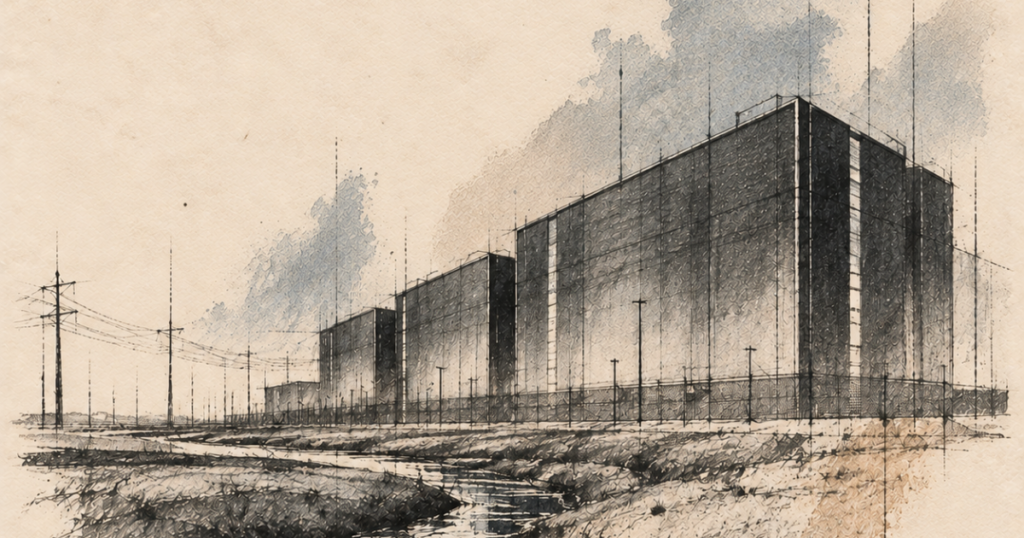
If it seems like everyone suddenly wants to build a data center, you are not imagining it. Across the United States, enormous data center projects are being proposed and constructed at a remarkable pace. They are showing up outside major cities, in rural communities, near power plants, and in places that probably never imagined themselves becoming part of the technology industry.
Some of these projects cost billions of dollars and require as much electricity as a small city. They can involve hundreds of acres of land, new electrical substations, transmission lines, backup generators, cooling systems, fiber connections, and significant water infrastructure. Increasingly, local governments and utilities are being asked to make decisions about tax incentives, zoning, electrical capacity, water access, and infrastructure improvements to accommodate them.
So what exactly are we building all of this for?
The short answer is artificial intelligence. The longer and more accurate answer is that AI has arrived on top of an already rapidly expanding digital world, creating an enormous new demand for computing power. Technology companies are now betting hundreds of billions of dollars that we are going to need much more of it.
First, What Is a Data Center?
Despite the futuristic name, a data center is essentially a building full of computers. Not laptops and desktop computers, of course, but rows upon rows of powerful servers connected to storage equipment, networking systems, and increasingly specialized computer chips.
Those computers perform much of the invisible work behind modern life. When you stream a movie, store photographs in the cloud, make an online purchase, use Google Maps, check your bank account, participate in a Zoom meeting, visit a website, play an online game, or back up your phone, computers somewhere have to process, transmit, or store that information.
That is an important thing to understand about “the cloud.” The cloud is not actually floating somewhere in the sky. It is physical infrastructure. It consists of buildings, computers, cables, electrical equipment, telecommunications networks, and cooling systems sitting somewhere on Earth.
We have needed data centers for decades. What has changed is the amount of computing companies believe we are going to need in the coming years.
Then AI Arrived
Artificial intelligence dramatically changed the equation. Systems such as ChatGPT and other generative AI tools require enormous amounts of computing power, particularly when companies are developing and training large AI models.
Training an advanced AI model involves processing huge quantities of information using extremely powerful computer processors. After the model has been trained, operating it for millions of users requires additional computing power. Every time someone asks an AI system to summarize a document, generate an image, write computer code, translate something, analyze information, or answer a question, computers somewhere have to perform the calculations necessary to produce that response.
One person’s request may not sound particularly significant. The scale changes when millions of people are making those requests and when companies begin incorporating AI into products people already use every day.
Now imagine AI being incorporated much more deeply into search engines, phones, vehicles, hospitals, schools, businesses, factories, scientific laboratories, financial institutions, military systems, and government agencies. Add autonomous AI agents that can perform tasks continuously rather than waiting for a person to type a question, and the potential computing demand becomes much larger.
That is the future technology companies are preparing for. They are not simply building enough data centers to accommodate the AI we use today. They are building for the amount of AI they believe we will use tomorrow.
The Great AI Bet
There is an important catch: nobody actually knows how much artificial intelligence humanity will be using ten years from now.
The technology industry is making an enormous bet that AI will become deeply integrated into ordinary life and business. Companies are preparing for a world in which AI assistants become commonplace, businesses automate large numbers of tasks, software developers routinely work alongside AI, scientists use it for research, factories incorporate increasingly intelligent robotics, and billions of AI interactions take place every day.
If that future arrives, enormous computing capacity will be necessary. But there is another reason companies are rushing to build now. They do not want to discover five years from now that artificial intelligence has become one of the most important technologies in the global economy while their competitors control most of the computing capacity necessary to operate it.
That creates something resembling an arms race. When one technology giant announces tens of billions of dollars in AI infrastructure investment, its competitors face tremendous pressure to keep up. Nobody wants to arrive late to what could become the next foundational technology.
This means companies are not necessarily waiting for demand to appear before constructing the infrastructure. They are attempting to build the infrastructure before the demand arrives. Some of that capacity may prove essential. Some may prove excessive. At this point, nobody can know precisely where that line will fall.
AI Isn’t the Only Thing Growing
It would be misleading, however, to blame the entire data center boom on artificial intelligence. Our ordinary digital lives were already expanding before the current AI boom began.
More businesses are moving their computer systems into the cloud. Streaming video continues to grow. People are storing enormous quantities of photographs and video. Financial transactions increasingly occur digitally. Online gaming, cybersecurity, telecommunications, social media, e-commerce, and remote work all require computing infrastructure. Governments, hospitals, universities, schools, and businesses maintain enormous databases that must be stored, protected, backed up, and accessed.
The internet itself keeps getting bigger. Artificial intelligence is not replacing all of that existing computing demand. It is being added on top of it.
In other words, two major trends are occurring at the same time. The first is the continued expansion of the internet and cloud computing that was already underway. The second is the rapid expansion of artificial intelligence. Together they are creating extraordinary demand for computing infrastructure.
The Digital World Is Surprisingly Hungry
This is where the data center story stops being merely a technology story and becomes an energy and infrastructure story.
Computers require electricity, and powerful computers require a great deal of it. Computers also generate heat, and that heat has to be removed continuously to prevent equipment from overheating. Modern high-performance data centers therefore need enormous electrical connections and sophisticated cooling systems.
Some facilities use significant amounts of water for cooling. Others use air cooling, closed-loop systems, or combinations of different technologies. The amount of water a particular data center uses can vary enormously depending on its design, location, climate, equipment, and operating practices. That is why broad claims that every data center will consume the same amount of water can be misleading. The details of the individual project matter.
Artificial intelligence makes the infrastructure challenge larger because specialized AI processors can concentrate extraordinary computing power, and therefore heat, into relatively small spaces. A large AI data center can consequently resemble an industrial facility much more than the quiet office building people may imagine when they hear the words “data center.”
It needs land, electricity, transmission infrastructure, fiber-optic connections, backup power, and cooling. Depending on its design, it may also require substantial water resources. Suddenly, the supposedly weightless digital world becomes very physical.
Why Are Data Centers Appearing in So Many Different Places?
Historically, data centers tended to cluster around established technology and telecommunications hubs. But those locations have limits. There is only so much available land, electrical capacity, transmission infrastructure, and water.
As demand increases, developers are looking farther afield. Communities with inexpensive land, available electrical capacity, favorable tax structures, existing fiber networks, and relatively easy permitting can become attractive locations even if they have never been associated with the technology industry before.
Cheap land certainly helps, but access to electricity can be even more important. A company proposing an enormous computing campus has to know that enough electricity can actually be delivered to it. In some places, the ability to secure hundreds of megawatts of electrical capacity may matter more than the price of the land itself.
This helps explain why communities that never considered themselves technology centers are suddenly receiving proposals for billion-dollar computing campuses. The digital economy is searching for physical resources, and it is increasingly looking beyond the places where the technology industry traditionally operated.
This Is Becoming an Energy Story
For decades, electricity demand in the United States grew relatively slowly. The rapid growth of data centers, along with other sources of new demand, is beginning to change that.
Large data centers can require extraordinary amounts of power. You cannot simply plug a gigantic AI computing campus into the electrical grid the way you would connect a new grocery store or subdivision. Very large facilities may require new substations, transmission upgrades, and additional electricity generation.
Utilities therefore have to determine where that electricity will come from and who will pay for the infrastructure necessary to deliver it. Depending on the location, additional demand could encourage new renewable generation, natural gas plants, nuclear power, battery storage, transmission construction, or some combination of those resources.
It can also create difficult questions for existing customers. If a utility spends enormous sums upgrading its system to accommodate a new industrial customer, communities have a legitimate interest in knowing how those costs will be allocated and what happens if the customer’s projected demand later changes.
The AI revolution, strangely enough, is becoming an electricity revolution too.
There Is Also a Global Power Race Happening
The data center boom is not only about technology companies selling AI subscriptions. Governments increasingly view advanced computing capacity as strategically important.
Advanced computing affects scientific research, economic competitiveness, cybersecurity, intelligence gathering, military technology, and national security. That means countries are not simply competing to create better AI software. They are increasingly concerned about controlling the infrastructure underneath it.
That infrastructure includes semiconductor manufacturing, advanced computer chips, electrical generation, telecommunications networks, and data centers. Computing capacity is beginning to look less like an ordinary business service and more like strategic national infrastructure.
In previous eras, nations worried about controlling access to steel, oil, railroads, shipping routes, and telecommunications. In this era, computing power is joining that list.
And Then There Is the Money
There is another force pushing the boom that should not be ignored: data centers have become an enormous investment opportunity. Technology companies are only part of the ecosystem. Private equity firms, infrastructure funds, real-estate developers, utilities, semiconductor manufacturers, construction companies, equipment suppliers, and financial institutions can all make money from the buildout.
Billions of dollars are therefore flowing into an industry based partly on current demand and partly on expectations of enormous future demand. That does not mean the demand is imaginary. It does mean financial incentives can contribute to building enthusiasm beyond what is strictly required by today’s needs.
That brings us to one of the most important questions surrounding the entire boom.
Do We Actually Need All of These Data Centers?
We definitely need more data centers. Modern society already depends heavily on digital infrastructure, cloud computing continues to expand, and artificial intelligence requires substantial computing capacity. But saying we need more data centers is not the same thing as saying every gigantic data center currently being proposed is necessary. Nobody knows that yet.
Much depends on how quickly AI adoption grows and what people ultimately use it for. It also depends on something technology has always been remarkably good at doing: becoming more efficient. Future computer chips may accomplish considerably more work while using less electricity. AI models may become more efficient. New cooling technologies may reduce resource consumption. Some forms of AI may become enormously popular while others fail completely.
Investors may also simply overestimate demand. History provides plenty of examples of genuine technological revolutions accompanied by speculative overbuilding. Railroads transformed civilization, but investors still built too many railroads in some places. The internet transformed the world, but the dot-com bubble still happened.
Artificial intelligence could profoundly reshape society while companies simultaneously overbuild portions of the infrastructure supporting it. Those two possibilities are not contradictory.
The Questions Communities Should Be Asking
This is why the public debate should not simply be reduced to whether data centers are “good” or “bad.” That framing tells us very little.
Data centers are becoming part of the infrastructure of modern civilization. Some projects may create genuine economic benefits, strengthen local tax bases, improve electrical infrastructure, or provide important computing capacity. Others may consume extraordinary amounts of electricity, water, or land while producing relatively few permanent jobs after construction is finished.
Communities therefore need much more specific information before deciding whether a particular project represents a good deal. Who is paying for the electrical infrastructure? How much water will the facility actually use? Where will its electricity come from? Will existing utility customers subsidize infrastructure built primarily for one enormous corporation? What tax revenue will the community actually receive after incentives are considered?
They should also ask how many permanent jobs will remain once construction ends, what environmental effects are expected, what contractual protections exist for the community, and what happens if the facility closes, changes ownership, requires additional resources, or becomes technologically obsolete.
Ultimately, the most useful question may be one of the oldest questions in economic development: Who receives the benefits, and who carries the risks?
Asking that question is not anti-technology. It is basic due diligence when a community is considering any enormous industrial development.
The Internet Was Never Really Invisible
For years, we have talked about the digital world as though it existed somewhere separate from the physical one. We upload things “to the cloud.” We stream movies. We search Google. We talk to artificial intelligence. The infrastructure behind those activities mostly remained invisible to ordinary people.
That is changing because the next stage of the digital revolution requires so much physical infrastructure that we are beginning to see it. We can see the buildings, transmission lines, substations, generators, cooling systems, and construction sites. We can measure the electricity they consume and the water they use.
We can also see some of the world’s wealthiest corporations arriving in communities to secure the land, electricity, infrastructure, and other resources necessary to operate those systems.
That may ultimately be the most important thing to understand about the data center boom. Artificial intelligence may exist in a digital environment, but the infrastructure required to power it exists in the physical world with the rest of us.
Data centers are not inherently sinister, nor are they inherently beneficial simply because they represent technological progress. They are massive pieces of industrial infrastructure being built during one of the largest technological investment races in modern history.
Some of that infrastructure will almost certainly prove necessary. Some may turn out to have been speculative. Much of it will shape electrical grids, land use, water planning, tax policy, and local development for decades.
That is why communities deserve more than promises that a project represents “innovation” or “economic development.” Before handing over land, electrical capacity, water access, tax incentives, or public infrastructure, the people who already live there deserve clear answers about exactly what is being built, why it is being built, what resources it will require, what benefits it will provide, and who will be responsible for the costs.
Because the cloud was never really a cloud.
It was infrastructure all along.